No posts for a couple of weeks, yours truly having been tasting the aesthetic delights of the Norwegian Fjords. It might have been the work of those omnipresent trolls or the waterfalls or caves that somehow in the darker recesses of my mind suggested the following, or it might have been a combination of all these. Or none. Who knows?
On Acquiring the Optimum Conditions for Creativity.
How wonderful to find a cave,
a shell-like structure, stone and brick,
you curled within, a perfect fit.
The world without, a distant myth.
And then to find as well your own
amenable dominatrix,
a muse with whip and concrete mix
to drive you in and seal the door.
How wonderful to kiss the whip,
be blinded to this half-blind world -
and deafened too, though foetus-like,
you listen to your mother's heart.
Your mother's heart lies at the heart
of music, poetry and art.
Its metronomic rhythms bind
the trolls composing in your mind.
How wonderful to feel the walls
cave out before your wall of sound,
to shatter like a singing glass,
or water ricocheted from rock.
How wonderful to be pitched back
into the bosom of the street,
submit again to hearing, sight...
and worship at her beauty feet.
Popular Posts
-
 As Antony Gormley's One and Other 100 days project for the fourth (empty) plinth in Trafalgar Square neared its conclusion I found mys...
 -
 It all depends, you see, how you go about it. And that I cannot tell you, for that will be dictated by you and by you knowing your friends...
 -
Hello everyone who follows David King (My Father). On behalf of the family this post is to let you know that Dad sadly passed away, peacefu...
-
The moon petals the sea. Rose petals the sea. Stone sea. Stone petals. Rose petals of stone. Stone rising before me. Sea moves. How moves...
-
A work in progress: 2 verses are in their first draft, the rest are in a second. So any feedback would be gratefully received. Pale and brit...
Sunday, 29 July 2007
Thursday, 12 July 2007
A Voice from the Silence
Recently I treated myself to a copy of Don Paterson's "Orpheus : A Version of Rilke". Fifty five sonnets to Orpheus, the originals having been completed by Rilke in under a month at a time when he was working on the Duino Elegies - when he was working to finish them, no less. It does not seem feasible. He spoke of writing them to dictation. Paterson is at pains to stress that what he has produced is a version, not a translation, and he includes a twelve page Afterword, plus an appendix of fourteen notes, all devoted, in the main, to an analysis of the contrasting natures of these two very different beasts. Incidentally, the book would have been well worth buying had it contained no more than the Afterword and the Appendix.
But they are merely a bonus. It does contain more. It contains fifty five stunning sonnets. I say that as an act of faith, for I have not yet read them all, not even half of them, but they will, I just know, be meat and drink to me for some time to come. (I guess I will take substantially longer to read them than Rilke took to write the originals.) But my purpose just now is not to discuss or eulogize about the sonnets, but to think upon the following, which Paterson quotes in the fourth of his Notes:
"Charles Simic once memorably remarked that poems are translations from the silence. For a version to be any kind of a real poem, it must first reinhabit that extralinguistic silence the original poem once itself enjoyed - which is to say the poem must make a symbolic exit from language altogether. In this meditative space, its pattern of idea and image is reconsumed by its own strangeness, and when it re-emerges into language rediscovers itself in original speech."
I think it is not too fanciful to say that I was aware of something akin to this - perhaps the obverse side of the process - as I chose and read some "taster" sonnets, and particularly the opening one, "Orpheus". I read the words, was aware of meaning (though not "the" meaning), as from the page came, a voice, certainly, but a voice in the silence. The language was not being internalised. It was meaning as you might encounter it in dream, not knowing by what means you had come by it, a ghostly flame flickering between me and the page. A brief moment, no more; a tick of the clock, but perhaps it was the eternal clock that had ticked.
Later,as I read them again, the spell was broken, and the language kicked in with its own enchantments. Later still, it occurred to me that there is often (always?) something of this to my first reading of any great poem. It would be interesting to know if this is a universal finding. Is it the same for all?
But they are merely a bonus. It does contain more. It contains fifty five stunning sonnets. I say that as an act of faith, for I have not yet read them all, not even half of them, but they will, I just know, be meat and drink to me for some time to come. (I guess I will take substantially longer to read them than Rilke took to write the originals.) But my purpose just now is not to discuss or eulogize about the sonnets, but to think upon the following, which Paterson quotes in the fourth of his Notes:
"Charles Simic once memorably remarked that poems are translations from the silence. For a version to be any kind of a real poem, it must first reinhabit that extralinguistic silence the original poem once itself enjoyed - which is to say the poem must make a symbolic exit from language altogether. In this meditative space, its pattern of idea and image is reconsumed by its own strangeness, and when it re-emerges into language rediscovers itself in original speech."
I think it is not too fanciful to say that I was aware of something akin to this - perhaps the obverse side of the process - as I chose and read some "taster" sonnets, and particularly the opening one, "Orpheus". I read the words, was aware of meaning (though not "the" meaning), as from the page came, a voice, certainly, but a voice in the silence. The language was not being internalised. It was meaning as you might encounter it in dream, not knowing by what means you had come by it, a ghostly flame flickering between me and the page. A brief moment, no more; a tick of the clock, but perhaps it was the eternal clock that had ticked.
Later,as I read them again, the spell was broken, and the language kicked in with its own enchantments. Later still, it occurred to me that there is often (always?) something of this to my first reading of any great poem. It would be interesting to know if this is a universal finding. Is it the same for all?
Sunday, 8 July 2007
Vision
"Vision" must be one of the most overworked words in the context of literary or artistic reviews and discussions. Every publisher's blurb, it seems, talks of "the author's vision". Art critics are no less fond of the epithet than their literary counterparts. So what, in these contexts, does the word mean? Very often, the author's or the artist's "vision" amounts to no more than his or her personal "take" on a particular subject. Sometimes it is doom-laden, as in: "The author's vision of the final days of global warming...", such a vision being something conjured from the depth of the imagination. It used to mean more. A "visionary" artist was one such as Samuel Palmer or William Blake. The word visionary was an accolade that marked him out, exalted him above his more mundane and realistic peers. As always, there would have been disagreement about which artists qualified for the honour, but about the nature of the honour itself there would have been more or less total concord. At that time it would most likely have been a supernatural vision - or an hallucination, depending upon your particular take on the subject. So, am I saying that to be visionary a work must record an actual visionary experience? Or can an artist or an author construct a vision from his or her imagination? It surely must involve more than a slickness with imagery, more than the twisting of a shape on canvas or a clever way with rhyme or assonance. Traditionally, the first essential would have been that it should possess a heightening effect to lift it out of the ordinary, one that was more than special effects or a device to achieve a coherent composition. And where the word "vision" retains its former meaning, that must still apply. In other words, it must compel with its authenticity; we must be convinced by a genuine spiritual quality, be able to see in it the signature of an active other world or life peeping into ours and having some effect upon it.
But away from its historical aspect, maybe there is another, equally worthy, equally valid: the artist or the author may have a "vision" in which s/he sees - and helps us to see - the world, or some small part of it - in a wholly new way. Van Gogh's "take" on the world has done so for many. We could argue endlessly as to whether his vision involves the penetration of another world into ours. For me it does not, but no one now sees sunflowers in quite the way they were seen before he painted them. Or consider the distortions of an El Greco painting, even those of the disciples in Leonardo's "Last Supper". Expressions of tension and spiritual struggle. The difference between the heightening effect of these on the one hand and van Gogh's on the other is not easy to convey, but is clear enough when the comparison is made. Looking at either of the former two we instinctively feel that the artist has reached us through something seen at the heart of each of us, an image of the eternal, some would say; a small particle of being that does not change whatever may be changing in the world around. Shelley, confirmed atheist that he was, had a sense of the spiritual and a drive towards self-knowledge that came together in his poetry, creating visions to open up that world for his readers, while for Wallace Stevens poetry could change the world by re-ordering what is there, re-creating the given. Van Gogh's "Sunflowers" can not give me that, however much I may glean from them.
But away from its historical aspect, maybe there is another, equally worthy, equally valid: the artist or the author may have a "vision" in which s/he sees - and helps us to see - the world, or some small part of it - in a wholly new way. Van Gogh's "take" on the world has done so for many. We could argue endlessly as to whether his vision involves the penetration of another world into ours. For me it does not, but no one now sees sunflowers in quite the way they were seen before he painted them. Or consider the distortions of an El Greco painting, even those of the disciples in Leonardo's "Last Supper". Expressions of tension and spiritual struggle. The difference between the heightening effect of these on the one hand and van Gogh's on the other is not easy to convey, but is clear enough when the comparison is made. Looking at either of the former two we instinctively feel that the artist has reached us through something seen at the heart of each of us, an image of the eternal, some would say; a small particle of being that does not change whatever may be changing in the world around. Shelley, confirmed atheist that he was, had a sense of the spiritual and a drive towards self-knowledge that came together in his poetry, creating visions to open up that world for his readers, while for Wallace Stevens poetry could change the world by re-ordering what is there, re-creating the given. Van Gogh's "Sunflowers" can not give me that, however much I may glean from them.
Friday, 29 June 2007
An Instinctive Follower of Fashion
It could be that I am at serious risk of mentioning Grayson Perry on a regular basis. He does seem to me to offer a rare (among art commentators) mixture of the interesting and eminently sensible. This last week he was commenting on the unlikely subject of art and sport. Or, more usually, sport and art. As he rightly (some might say, obviously) pointed out, sporting art, like any other art, can only rise to greatness when done for art's sake.
As a young boy I would stand, fascinated, before a large reproduction of a Victorian painting that hung in my grandparents' hallway. Its title was: "An Evening at the National Sporting Club". The subject: boxing. It depicted the ring, the contestants, the officials and the great and the good who had assembled to watch the sport. But what fascinated me was not the painting itself, but the full sized key hanging beside it which identified those depicted there. As far as I remember, every individual in that crowded arena was given his or her name, rank and number. The painting itself was a typical piece of Victoriana - and definitely done for the sake of neither sport nor art, but for the sake of a certain social snobbery. Nevertheless, it fascinated me; without even knowing it, I was instinctively in tune with the fashion, the zeitgeist even.
Wind on a few years and I have made it to grammar school by the plaque on the skin of my teeth. There I came into contact with an art teacher who was inspirational - as most of the others were not. Furthermore, he had a passion for cycle (road) racing, as did I. Road racing as we know it today was not permitted by law, back then. It was confined to time trialling, and in order to follow or take part in it, one had to be up and about in the (very) wee hours of the morning when the roads were empty of other users. How different today, with The Tour de France about to bring its life and colour to London and the South East for a couple of days. Nearly 200 riders on our roads, bringing with them a bonus of over a £1,000,000! But to return: it came to pass that one afternoon this inspirational art teacher painted for us a brilliant word picture of an attempt on the London to Brighton record, at the conclusion of which account he told us to paint whatever his words had suggested to us. I remember that I painted a yellow circle on a wholly black background. When asked what it was, I explained that the event had taken place at night, so all you could see was his headlight coming towards you. In my defence I would point out that I had used the golden mean to calculate the size and position of the disc of light. The ghosts of Neo-plasticism applauded, I am sure. I was actually very proud of my work. I had not heard of Neo-plasticism back then, though I was about to be introduced to it by that same inspirational teacher. Once again, I was instinctively in step with the prevailing fashion (albeit one slightly on the wane), and still all unaware. Weird. Very worrying! Could this really be the future, I ask myself?

As a young boy I would stand, fascinated, before a large reproduction of a Victorian painting that hung in my grandparents' hallway. Its title was: "An Evening at the National Sporting Club". The subject: boxing. It depicted the ring, the contestants, the officials and the great and the good who had assembled to watch the sport. But what fascinated me was not the painting itself, but the full sized key hanging beside it which identified those depicted there. As far as I remember, every individual in that crowded arena was given his or her name, rank and number. The painting itself was a typical piece of Victoriana - and definitely done for the sake of neither sport nor art, but for the sake of a certain social snobbery. Nevertheless, it fascinated me; without even knowing it, I was instinctively in tune with the fashion, the zeitgeist even.
Wind on a few years and I have made it to grammar school by the plaque on the skin of my teeth. There I came into contact with an art teacher who was inspirational - as most of the others were not. Furthermore, he had a passion for cycle (road) racing, as did I. Road racing as we know it today was not permitted by law, back then. It was confined to time trialling, and in order to follow or take part in it, one had to be up and about in the (very) wee hours of the morning when the roads were empty of other users. How different today, with The Tour de France about to bring its life and colour to London and the South East for a couple of days. Nearly 200 riders on our roads, bringing with them a bonus of over a £1,000,000! But to return: it came to pass that one afternoon this inspirational art teacher painted for us a brilliant word picture of an attempt on the London to Brighton record, at the conclusion of which account he told us to paint whatever his words had suggested to us. I remember that I painted a yellow circle on a wholly black background. When asked what it was, I explained that the event had taken place at night, so all you could see was his headlight coming towards you. In my defence I would point out that I had used the golden mean to calculate the size and position of the disc of light. The ghosts of Neo-plasticism applauded, I am sure. I was actually very proud of my work. I had not heard of Neo-plasticism back then, though I was about to be introduced to it by that same inspirational teacher. Once again, I was instinctively in step with the prevailing fashion (albeit one slightly on the wane), and still all unaware. Weird. Very worrying! Could this really be the future, I ask myself?

Friday, 22 June 2007
Only God and Eliot
An anecdote featuring Seamus Heaney sparked a lengthy train of thought and recall in me recently. It was a retelling by Martha Kapos in the summer edition of Poetry London of Heaney's own account in "Finders Keepers". Seamus Heaney, the story goes, received a copy of T.S. Eliot's "Collected" as a lad away at boarding school. It was "wrapped like a food parcel". This was in the fifties, at a time when Elliot was the main man, the guiding light of poetry, so you might think he (Heaney) would have regarded it as manna from heaven, seen the poems as a revelation even. Not so: they made him ill. He suffered something akin to a panic attack, complete with all the psycho-somatic symptoms that are the well-known associates of such attacks. The cause: he simply could not understand the poems, make any sense of Eliot's words. He prayed (in some sort of way) for a "paraphrasable meaning" to come to him, but none did. Repeated re-readings took him no further: the lines would not release their secrets.
Pausing there for a moment, I find the story reassuring on at least two counts. Initially, because if Heaney could make no sense of Eliot's lines, then there is no need for us to feel inadequate, hopeless or inferior (except perhaps by Heaney's standards) when we fail to unravel some obscurity or fail to find "the paraphrasable meaning" of something by Eliot, Pound, Stevens et al. Reassuring also, because the implication is that the quest for such a meaning is a search for the non-existent. I remember fondly when that thought, or something very like it, first occurred to me, what a difference it made to me, and has done ever since. But if I recall fondly, it is not with any great clarity, alas. I do remember that I was reading a book (or essay) on the writings and association of Pound and Fenellosa. In it there was an image of the poet as one fishing in troubled waters. Reading the editorial by Kapos has brought it all back: my thoughts and my excitement at the time. She quotes Stevens's remark that "A poem must resist the intelligence almost successfully." Obscurity in poetry, she points out, is not an encounter with a stretch of muddy water which repeated (and, no doubt, intelligent) reading will make transparent. No, my own analogy would be with the white water thrown up by the words thrashing about below the surface as the poet stretches their natural meaning to take the language beyond itself in order to express the inexpressible. The meaning lies at a level beyond or below (you choose) the intelligence - which is why it is possible to respond to a poem before it has been understood - and go on enjoying it even if it is never completely "understood". Unlike muddy water, white water can be read. It takes time, knowledge and experience, but in the meantime intuition can be doing a passable job.
My title, "Only God and Eliot", is taken from something a colleague said to me years back in the staff room, one of those apparently insignificant remarks that for some reason decided to hang around in the memory: "The Waste Land, only God and Eliot know what that's about - and I wouldn't go betting on God!"
Pausing there for a moment, I find the story reassuring on at least two counts. Initially, because if Heaney could make no sense of Eliot's lines, then there is no need for us to feel inadequate, hopeless or inferior (except perhaps by Heaney's standards) when we fail to unravel some obscurity or fail to find "the paraphrasable meaning" of something by Eliot, Pound, Stevens et al. Reassuring also, because the implication is that the quest for such a meaning is a search for the non-existent. I remember fondly when that thought, or something very like it, first occurred to me, what a difference it made to me, and has done ever since. But if I recall fondly, it is not with any great clarity, alas. I do remember that I was reading a book (or essay) on the writings and association of Pound and Fenellosa. In it there was an image of the poet as one fishing in troubled waters. Reading the editorial by Kapos has brought it all back: my thoughts and my excitement at the time. She quotes Stevens's remark that "A poem must resist the intelligence almost successfully." Obscurity in poetry, she points out, is not an encounter with a stretch of muddy water which repeated (and, no doubt, intelligent) reading will make transparent. No, my own analogy would be with the white water thrown up by the words thrashing about below the surface as the poet stretches their natural meaning to take the language beyond itself in order to express the inexpressible. The meaning lies at a level beyond or below (you choose) the intelligence - which is why it is possible to respond to a poem before it has been understood - and go on enjoying it even if it is never completely "understood". Unlike muddy water, white water can be read. It takes time, knowledge and experience, but in the meantime intuition can be doing a passable job.
My title, "Only God and Eliot", is taken from something a colleague said to me years back in the staff room, one of those apparently insignificant remarks that for some reason decided to hang around in the memory: "The Waste Land, only God and Eliot know what that's about - and I wouldn't go betting on God!"
Monday, 18 June 2007
Dirty Linen
Something rather strange has happened: a review of an artist whose work I have not seen has caused me to re-examine my response(s) to an artist with whose work I though I had come to terms.
The stereotypical response to modern art ("My five year old could do as well!"), has long since suffered modification in the face of artifacts from the likes of Damien Hirst (the shark in formaldehyde is technically beyond the range of most five year olds) and Tracey Emin (You wouldn't want your five year old to tackle her subject matter) to the slightly more accommodating, "But it's not really art is it?".
I must confess to having been unsure of my own response(s) to Emin. Was she merely out to shock? The thing about that infamous bed, for example, is that it only shocks because it is her bed. The same bed exhibited as a statement about some aspect of, for want of better expression, the seamy side of life, would have been acceptable to many who were offended by the knowledge that it was hers.But hers it is. In fact everything is hers, or has been so far. So what's behind it all? Is it therapy? But if it is therapy, should it not be more private? Less in our faces? Much art is therapeutic, of course. Some would say all art, but I might have a problem with that "all". Certainly there is a line between art and therapy, which some art straddles and some does not. I might concede that in Aristotelian phrase all great art purges the soul of the negative passions with which it conjures. Certainly, too, Emin's work is there on the front line of that great divide, sometimes straddling it, sometimes not quite managing to do so - in my opinion.
This year Emin has been our representative at the Venice Biennale. The various reviews that I have read of her exhibits have been less extreme than we have become used to over the years: less laudatory, less condemnatory. Kinder, certainly. But at the same time they have tended to compare her unfavourably with an artist in a nearby pavilion, Sophie Calle. Calle is in many ways, it seems, the French Tracey Emin, the High Priestess of what my mother would have called "dirty linen being washed in public". A while back, Calle was the recipient of a dumping text message from her boy friend. It seems to have had a profound effect on her. After a couple of days she showed it to a friend, seeking suggestions as to how best to reply. Then she showed another friend. In fact, she ended up sending copies to a hundred and seven friends and acquaintances, asking them to analyse the text in the sort of terms they would habitually use in their professions. So an editor considered it in terms of its use of grammar and style, an etiquette consultant for manners, and so forth. But what began as therapy (successful therapy, as it happened, for "the project replaced the person"), became art. The resulting hundred and seven texts constitute her exhibit at the Venice Biennale.
When I first read of this (not having read the texts, of course), I thought what a brilliant idea! It was an idea that seemed to suggest all manner of possibilities to me - even if a philistine or a pedant might have been forgiven for suggesting that the work was verging ever so slightly, towards the literary rather than the visual arts, but that is another story. My next thought was: How Tracey Emin-like! And then: What if it had been Emin who had "produced" (collated?) these texts? Would the critics and commentators have bestowed the same compliments upon them?
The stereotypical response to modern art ("My five year old could do as well!"), has long since suffered modification in the face of artifacts from the likes of Damien Hirst (the shark in formaldehyde is technically beyond the range of most five year olds) and Tracey Emin (You wouldn't want your five year old to tackle her subject matter) to the slightly more accommodating, "But it's not really art is it?".
I must confess to having been unsure of my own response(s) to Emin. Was she merely out to shock? The thing about that infamous bed, for example, is that it only shocks because it is her bed. The same bed exhibited as a statement about some aspect of, for want of better expression, the seamy side of life, would have been acceptable to many who were offended by the knowledge that it was hers.But hers it is. In fact everything is hers, or has been so far. So what's behind it all? Is it therapy? But if it is therapy, should it not be more private? Less in our faces? Much art is therapeutic, of course. Some would say all art, but I might have a problem with that "all". Certainly there is a line between art and therapy, which some art straddles and some does not. I might concede that in Aristotelian phrase all great art purges the soul of the negative passions with which it conjures. Certainly, too, Emin's work is there on the front line of that great divide, sometimes straddling it, sometimes not quite managing to do so - in my opinion.
This year Emin has been our representative at the Venice Biennale. The various reviews that I have read of her exhibits have been less extreme than we have become used to over the years: less laudatory, less condemnatory. Kinder, certainly. But at the same time they have tended to compare her unfavourably with an artist in a nearby pavilion, Sophie Calle. Calle is in many ways, it seems, the French Tracey Emin, the High Priestess of what my mother would have called "dirty linen being washed in public". A while back, Calle was the recipient of a dumping text message from her boy friend. It seems to have had a profound effect on her. After a couple of days she showed it to a friend, seeking suggestions as to how best to reply. Then she showed another friend. In fact, she ended up sending copies to a hundred and seven friends and acquaintances, asking them to analyse the text in the sort of terms they would habitually use in their professions. So an editor considered it in terms of its use of grammar and style, an etiquette consultant for manners, and so forth. But what began as therapy (successful therapy, as it happened, for "the project replaced the person"), became art. The resulting hundred and seven texts constitute her exhibit at the Venice Biennale.
When I first read of this (not having read the texts, of course), I thought what a brilliant idea! It was an idea that seemed to suggest all manner of possibilities to me - even if a philistine or a pedant might have been forgiven for suggesting that the work was verging ever so slightly, towards the literary rather than the visual arts, but that is another story. My next thought was: How Tracey Emin-like! And then: What if it had been Emin who had "produced" (collated?) these texts? Would the critics and commentators have bestowed the same compliments upon them?
Tuesday, 12 June 2007
A Walk in the Woods
I pinched this poem from my website. I had intended to include it with yesterday's image, which is where it really belongs, but then thought that I didn't want to take the focus from the Ghazals.
The leaves move in the wind -
or moving leaves create the wind.
Mysterious, the wood through which I walk,
and hung with possibilities I thought
we had resolved in childhood.
A greenness, as of ocean,
overwhelms; its weight makes
dizzy, twangs the brambles round the feet, entwined
like broken cello strings. If trees were people
we would call them bullies, yet they wait,
patient as the mist above the pond
and like a million fibres hung
with stars, as though a million
spiders had a million thoughts
and could not stay with one.
We look for stasis, but the spiders know
the world is built on motion, they are one
with it, their webs are sexual, are moments
of completion, their only absolutes -
in moments torn to pieces.
Each ecstasy brings forth another
like itself. Beyond life hangs life's image
in another web. Between the roots
and canopy the trunks impose
their discipline, a regularity
of space and form. Things follow things,
there are no final moments, final states.
Mysterious the wood, and hung
with possibilities. And yet, and yet
we cannot move without the web is torn.
The leaves move in the wind -
or moving leaves create the wind.
Mysterious, the wood through which I walk,
and hung with possibilities I thought
we had resolved in childhood.
A greenness, as of ocean,
overwhelms; its weight makes
dizzy, twangs the brambles round the feet, entwined
like broken cello strings. If trees were people
we would call them bullies, yet they wait,
patient as the mist above the pond
and like a million fibres hung
with stars, as though a million
spiders had a million thoughts
and could not stay with one.
We look for stasis, but the spiders know
the world is built on motion, they are one
with it, their webs are sexual, are moments
of completion, their only absolutes -
in moments torn to pieces.
Each ecstasy brings forth another
like itself. Beyond life hangs life's image
in another web. Between the roots
and canopy the trunks impose
their discipline, a regularity
of space and form. Things follow things,
there are no final moments, final states.
Mysterious the wood, and hung
with possibilities. And yet, and yet
we cannot move without the web is torn.
Sunday, 10 June 2007
Magic Realism or Parallel Subject Matter

Recently a friend sent me some interesting texts on, and links to, the work of Rob Gonsalves. Totally new to me. "Magic realism" painting of a kind I find intriguing. At the time, it just so happened, I was digitally doodling, playing with ideas that I at once saw reflected in Gonsalves's work. As if that was not enough to stop me in my stride, whilst surfing on the web I then came by accident upon a new (to me) poetic form, The Ghazal (pronounced "guzzle"). It seemed to embody some of the same attributes. Since when I have been largely researching the Ghazal, though what I have unearthed to date is fairly elementary.
The Ghazal comes to us from ancient Persia (a few sources I have found, mention India). It derives from a pre-Islamic, conversational form and consists of a series (no more than a dozen or so, usually) of couplets, mostly end-stopped, strung together by a common rhythm and rhyme scheme, but unconnected by any form of narrative or logical association. Initially, they struck me as being related in the way that a young child at the autistic stage of development relates things and incidents; pointing perhaps to a steaming kettle and saying "Puff, puff mummy!" - though not these days, of course! This freedom from the restraints of subject matter opens up realms of possibilities in love and mystical poetry - and in much more, not least in magic realism and surrealism.
The first couplet (the matla) has a rhyme pattern (kaffiyaa) followed by a short refrain (a word or a phrase, the radij) at the end of each line. Thereafter, in each couplet we find that the first line is free, while the following one ends in the kaffiyaa and the radij. The two lines of a couplet may not even have the same number of feet and may themselves be unrelated. Each couplet may be a compete poem in itself, but thought and/or feeling should leap from one to the next. Connections may be sensed, but are usually not expressable in words.
There is something here that I was experimenting with, trying to capture with my digital doodling, what I have called parallel subject matter. The image reproduced here is the first - and so far only - one to have made it to a presentable stage of development. From it came the idea that was beginning to fascinate me when I encountered, first Gonsalves and then the Ghazal. If all goes well, these will appear, no doubt in some future posting(s). But who knows. Meanwhile, should any reader have, or encounter, any knowledge that would add to or correct anything I have included here, a word to the wise (myself) would be much appreciated.
It has been said that it is easy to write a Ghazal, but exceedingly difficult to write one well - I know, you could say that about, well, almost anything, but whereas free verse, for example, may hide a poet's mediocrity, a ghazal will highlight it. It is perhaps the Bedouin equivalent of the Western World's sonnet.
link to Gonsalves
link to Gonsalves
The Ghazal
Sunday, 3 June 2007
Wordsworth in Rap?
Our culture has something of a problem with fun. We pay lip service to it: if asked about an event or activity we have recently been engaged in, we are as like as not to say: "Oh, it was fun!", but scratch the surface and the record sticks, the inappropriateness or the insincerity shows through. The remark did not say what it said.
Radio 4 attempted the nigh-impossible just recently: they ran a programme in their Ha Ha series, called Ha Ha Art. It was, of course, all Ha Ha and no art, though it did make one telling point: that when the subject (humour, fun, whatever...) begins to get "serious" we approach it as outsiders.
Think of two or three works of art that have meant something to you... go on, say "The Ring"! No? Okay, you don't really have to get that serious... Got them? Can you honestly say that you think them fun? Any of them? All of them? If you can manage one yes, I congratulate you, but now there's a supplementary: can you imagine any of our worthy critics confessing to having found them "fun" - as part of a "serious" critical appraisal of the work concerned? I have heard such confessions on occasion, but it's very unusual and mostly confined to certain genres.
In a previous life I was, for my sins, a Methodist lay preacher. I always felt extremely uncomfortable when some kind soul would say to me after a service that she (It nearly always was a she.) had enjoyed the sermon. The Protestant ethic, as I was taught it, did not allow for sermons to be enjoyed. They were supposed to make the good worshipper uncomfortable in the presence of the Almighty. After all, if the flesh is enjoying something, it can't be doing the soul much good. Or can it? (I suspect that we have two souls, incidentally, an aesthetic soul and an eternal soul - maybe the first, with a little T.L.C., can develop into the second, but neither of them can find room for fun, that would seem a rum do.) The idea sticks, that medicine, to do you good, must not have a pleasant taste.
A few days ago I overheard some mothers talking about the staff at their children's school. They (the staff) had "taken themselves off" to some comfortable, not to say luxurious, watering hole for a few days for a conference. Ha! Ha! was the response of the mothers to that! - and they may have been right, for after all, they know the staff concerned! What concerns me, though, is their assumption, stated forcibly by several, that whatever the motives of the teachers, nothing of any practical value was going to come out of the jaunt because they were all having fun! The two just do not mix.
I'm not advocating Wordsworth in rap, or anything for that matter in terms of creating art. Simply that we try to look at, or listen to, art free from the usual spin and assumptions. For example, I have always found Brueghel's "Icarus" amusing, fun, humorous - I don't really mind which tag you apply. Yes, there's a trth being illustrated here, but surely I can't be alone in thinking there's a bit of fun going on as well. Or can I? I first saw a reproduction of it when I was quite young, and found it amusing before anyone told me how serious it was - as though the two were mutually exclusive - and now that Auden's poem has imbued it with another layer of seriousness, you can be looked at askance if you own to finding it fun.
Another question: how many works can you think of (without too much effort) that might be thought fun? Or how many artists whose name is associated in your mind with fun. I would think of Brueghel's Icarus (naturally!), Beardsley and Hogarth and, for poetry, Under Milk Wood (An obvious choice? But wait for my next - and last - question.), then almost any Mira, Dali, Toulouse-Lautrec, Matta, Koons, Lowry, de Kooning or Tinguely's sculptures. (I have purposely avoided some areas, eg Shakespeare plays, but you will think of many that I could have included.) You have your list? How many in that list could you also deem to be serious? I will have a bet that this last question is easier than was my first.
Radio 4 attempted the nigh-impossible just recently: they ran a programme in their Ha Ha series, called Ha Ha Art. It was, of course, all Ha Ha and no art, though it did make one telling point: that when the subject (humour, fun, whatever...) begins to get "serious" we approach it as outsiders.
Think of two or three works of art that have meant something to you... go on, say "The Ring"! No? Okay, you don't really have to get that serious... Got them? Can you honestly say that you think them fun? Any of them? All of them? If you can manage one yes, I congratulate you, but now there's a supplementary: can you imagine any of our worthy critics confessing to having found them "fun" - as part of a "serious" critical appraisal of the work concerned? I have heard such confessions on occasion, but it's very unusual and mostly confined to certain genres.
In a previous life I was, for my sins, a Methodist lay preacher. I always felt extremely uncomfortable when some kind soul would say to me after a service that she (It nearly always was a she.) had enjoyed the sermon. The Protestant ethic, as I was taught it, did not allow for sermons to be enjoyed. They were supposed to make the good worshipper uncomfortable in the presence of the Almighty. After all, if the flesh is enjoying something, it can't be doing the soul much good. Or can it? (I suspect that we have two souls, incidentally, an aesthetic soul and an eternal soul - maybe the first, with a little T.L.C., can develop into the second, but neither of them can find room for fun, that would seem a rum do.) The idea sticks, that medicine, to do you good, must not have a pleasant taste.
A few days ago I overheard some mothers talking about the staff at their children's school. They (the staff) had "taken themselves off" to some comfortable, not to say luxurious, watering hole for a few days for a conference. Ha! Ha! was the response of the mothers to that! - and they may have been right, for after all, they know the staff concerned! What concerns me, though, is their assumption, stated forcibly by several, that whatever the motives of the teachers, nothing of any practical value was going to come out of the jaunt because they were all having fun! The two just do not mix.
I'm not advocating Wordsworth in rap, or anything for that matter in terms of creating art. Simply that we try to look at, or listen to, art free from the usual spin and assumptions. For example, I have always found Brueghel's "Icarus" amusing, fun, humorous - I don't really mind which tag you apply. Yes, there's a trth being illustrated here, but surely I can't be alone in thinking there's a bit of fun going on as well. Or can I? I first saw a reproduction of it when I was quite young, and found it amusing before anyone told me how serious it was - as though the two were mutually exclusive - and now that Auden's poem has imbued it with another layer of seriousness, you can be looked at askance if you own to finding it fun.
Another question: how many works can you think of (without too much effort) that might be thought fun? Or how many artists whose name is associated in your mind with fun. I would think of Brueghel's Icarus (naturally!), Beardsley and Hogarth and, for poetry, Under Milk Wood (An obvious choice? But wait for my next - and last - question.), then almost any Mira, Dali, Toulouse-Lautrec, Matta, Koons, Lowry, de Kooning or Tinguely's sculptures. (I have purposely avoided some areas, eg Shakespeare plays, but you will think of many that I could have included.) You have your list? How many in that list could you also deem to be serious? I will have a bet that this last question is easier than was my first.
Monday, 28 May 2007
Myths and Antony Gormley
I have been taken gently to task by a correspondent who accuses me of two sins, one of omission and the other of commission - though I am not sure which is which. One concerns my post on Antony Gormley (13 May) and the other, my article on "Myth: Public and Personal" (21 May), though both relate to the work of Antony Gormley.
Did I not realise, John (of Chesterfield) asks, that many of Antony Gormley's figures are cast, not from his own body, but from the bodies of others - mostly friends and volunteers? Well, yes I did and I apologise for the slip, though in truth I had not realised the extent to which he uses others, had I done so I would have noted it in my post, so I suppose that is a slip both of commission and omission. For some installations friends and volunteers have been numbered in the hundreds, I now realise.
The other point is more fundamental, and the reason for this reply. Furthermore, by a remarkable coincidence the same point was made - in a somewhat different form - in an article on Gormley published in last Saturday's Guardian: that the artists of genius who changed art for ever early in the last century and who, in doing so, "gave us" primitive art, took no interest in the cultures from which that art came - and therefore took no interest in the "meaning" of the artifacts from which they lifted what merely took their fancy. In other words, they took no interest in the myths behind the art works that they plundered.
John's contention is that Gormley is pre-eminent among the few who have taken such an interest, who have explored the cultural "meaning" of the artifacts and have found inspiration (and more than inspiration - a driving force) in the belief systems underlying the art. His art is not about "isolation in isolation" (Did I suggest it was?), but about how we live alone and with one another, about society, in other words, and the myths that sustain or threaten it and us. And about the artifacts that carry those myths.
There are points here worthy of further thought and research, I feel.
Did I not realise, John (of Chesterfield) asks, that many of Antony Gormley's figures are cast, not from his own body, but from the bodies of others - mostly friends and volunteers? Well, yes I did and I apologise for the slip, though in truth I had not realised the extent to which he uses others, had I done so I would have noted it in my post, so I suppose that is a slip both of commission and omission. For some installations friends and volunteers have been numbered in the hundreds, I now realise.
The other point is more fundamental, and the reason for this reply. Furthermore, by a remarkable coincidence the same point was made - in a somewhat different form - in an article on Gormley published in last Saturday's Guardian: that the artists of genius who changed art for ever early in the last century and who, in doing so, "gave us" primitive art, took no interest in the cultures from which that art came - and therefore took no interest in the "meaning" of the artifacts from which they lifted what merely took their fancy. In other words, they took no interest in the myths behind the art works that they plundered.
John's contention is that Gormley is pre-eminent among the few who have taken such an interest, who have explored the cultural "meaning" of the artifacts and have found inspiration (and more than inspiration - a driving force) in the belief systems underlying the art. His art is not about "isolation in isolation" (Did I suggest it was?), but about how we live alone and with one another, about society, in other words, and the myths that sustain or threaten it and us. And about the artifacts that carry those myths.
There are points here worthy of further thought and research, I feel.
Saturday, 26 May 2007
Have You Done?
The Massachusetts Museum of Contemporary Art, a fairly insignificant institution, smaller than France or Germany, is in dispute with one of its intended exhibitors, Christoph Büchel, a Swiss artist whose installation is the bone of contention. Büchel began assembling his work last year for a show, The Training Ground of Democracy, that was due to open in December. To date he has assembled in its football pitch-sized hall, an oil tanker, a smashed police car, and a two-story house that was cut into four and reassembled indoors. Obviously, Büchel has no intention of stopping there, and does not wish the visitors to view it in its present unfinished state. The Mass Mus, on the other hand, maintain that a lot of people have put a lot of blood, sweat and tears into the show, and the people are entitled to walk past and view the growing pile of materials being assembled.
My interest in all this lies in the fact that it has resurrected another of those conundrums that once exercised the best brains of my art school (see blog 18 Jan : It's How He Sees It): When exactly, is a work of art finished?
With some works the answer is clear enough. A statue, once the final casting has been made, would not normally cry out for more to be done to it - although even here there might be some room for disagreement. A fresco, on the other hand, is finished (I guess) when the last bit of plaster has dried. All things are a matter of degree, of course, for the problem becomes critical in the case of some art forms. A watercolour, treated to one brush stroke too many, can go from a sparkling clarity that is the joy of the medium, to a muddy patch, fit only for the growing of vegetables.
In the case of poetry, the situation changes again. Here you may change and develop to your heart's content, knowing that you will always have the original, or the previous, version to fall back on if you overdo things. It is well said (for many poets, at least) that a poem is never finished, only abandoned.
The case of poetry raises another question: at what point does a new version become a new poem? It sounds like a false conundrum, does it not? Analogous to: at what point is a twisted belt, twisted. But it highlights a deeper dilemma: should we always accept the creator's view of these matters? Is there an alternative? Maybe there is no way in which the poser could be answered in terms both absolute and aesthetic, but what about in moral terms? And if there is a moral answer, could it be important, or is it only the aesthetic that matters where art is concerned? Again, if there is a moral aspect, will that always be on the side of the artist? Let me put a hypothetical question: I have entered a poem for a major competition and it has been placed first by the judges. However, the rules of the competition state that it must not have been previously published. Unfortunately, in the opinion of the sponsors, it has. Or has it? They point to an earlier version that was published in a magazine, but I claim (and genuinely believe) that to have been a different poem: some lines were the same (How many does it take?), but it is shorter, has a different title, the structure has changed, the lineation is different, etc, etc - How much does it take? Whose judgment should prevail, and on what basis? The art world in America is finding it very difficult to adjudicate between Büchel and the MMoCA - which is why the latter is taking Büchel to court for a judicial ruling. Shame it should go that far.
My interest in all this lies in the fact that it has resurrected another of those conundrums that once exercised the best brains of my art school (see blog 18 Jan : It's How He Sees It): When exactly, is a work of art finished?
With some works the answer is clear enough. A statue, once the final casting has been made, would not normally cry out for more to be done to it - although even here there might be some room for disagreement. A fresco, on the other hand, is finished (I guess) when the last bit of plaster has dried. All things are a matter of degree, of course, for the problem becomes critical in the case of some art forms. A watercolour, treated to one brush stroke too many, can go from a sparkling clarity that is the joy of the medium, to a muddy patch, fit only for the growing of vegetables.
In the case of poetry, the situation changes again. Here you may change and develop to your heart's content, knowing that you will always have the original, or the previous, version to fall back on if you overdo things. It is well said (for many poets, at least) that a poem is never finished, only abandoned.
The case of poetry raises another question: at what point does a new version become a new poem? It sounds like a false conundrum, does it not? Analogous to: at what point is a twisted belt, twisted. But it highlights a deeper dilemma: should we always accept the creator's view of these matters? Is there an alternative? Maybe there is no way in which the poser could be answered in terms both absolute and aesthetic, but what about in moral terms? And if there is a moral answer, could it be important, or is it only the aesthetic that matters where art is concerned? Again, if there is a moral aspect, will that always be on the side of the artist? Let me put a hypothetical question: I have entered a poem for a major competition and it has been placed first by the judges. However, the rules of the competition state that it must not have been previously published. Unfortunately, in the opinion of the sponsors, it has. Or has it? They point to an earlier version that was published in a magazine, but I claim (and genuinely believe) that to have been a different poem: some lines were the same (How many does it take?), but it is shorter, has a different title, the structure has changed, the lineation is different, etc, etc - How much does it take? Whose judgment should prevail, and on what basis? The art world in America is finding it very difficult to adjudicate between Büchel and the MMoCA - which is why the latter is taking Büchel to court for a judicial ruling. Shame it should go that far.
Monday, 21 May 2007
Myths : Personal and Public
The May edition of "Acumen", a quarterly periodical of New Poetry and Reviews, carried the response to a call the editor had sent out for the views of poets on the question of whether we (poets, presumably) still need myths. Seventeen, mainly short, replies which occasioned a change of title from "Myths: do we still need them?" to "Myths: why we still need them".
It seems to me that if we are to talk about myths and their place in the creation of art works, then there are three distinct classifications of myth that we might consider: there are the living myths that are the basis of our world's faiths and cultures, vibrant influences in the lives of those who hold them; there are what many would call the dead myths of past faiths and cultures, those of ancient Rome, Greece, China, Egypt or wherever: and there are those that for me at any rate are responsible for the most profoundly resonating works of contemporary art, the private and personal myths that the artist has hammered out for his or herself. I am thinking. for example, of the poems of William Blake and his myth of Albion (and would The Women's Institute sing his Jerusalem as lustily - I use the word advisedly - if they knew what the words meant? ), of Stanley Spencer's myth of Christ coming to Cookham (a myth of the future), of Antony Gormley's sculpture (see previous post), of the "Crow" myths of Ted Hughes and of the myths of absence in the poems of John Burnside, but I could go on indefinitely. You, no doubt could add as many more.
It was not always so. Once the most profoundly resonating myths would have been those that were shared by the vast majority, the myths that had to do with a shared faith. Why the change? There are many reasons. Some no doubt have to do with the cult of individuality and personality, but perhaps also it is that, whereas once the artist would have been a man (usually a man) of faith who just happened to be an artist by trade, working in an artistic tradition which incorporated the shared faith of his people, today he (or she) is more likely to be an artist who just happens to hold a particular faith. One other possibility I have already mentioned: that of the artist who has forged for her or himself a personal and private myth. Where that is the case I often think I hear the hammer blows of that forging resounding in the resulting works.
One of the great myths has to do with descent and rising again. We find it in the Orpheus narrative and, of course, in the Gospels of Jesus Christ. When our western cultures first signed up to the latter, the stage was set for a rich development of a powerful myth that could have taken the new learning which was to come effortlessly in its stride. Science and technology (which it helped to midwife and nuture by insisting that the world was planned, that there was order, logic and explanations to be found) would have fallen into place alongside the ancient elements. There were perhaps three reasons why this did not happen: the obsession of academia with Greco-Roman culture and its myths, the insistence of the Roman Catholic Church that only the inner cabal of Pope and cardinals could interpret the myth to an ignorant populace (which they did without ever allowing the slightest breath of change), and the insistence of the Protestant churches that the Holy texts were immutable. In the face of these three stone walls what should have been a poetic drama featuring the representative of both God and man, the folk hero, achieving for the race the potential of the race, became instead an unimaginative stasis, a drying-up of what Coleridge referred to as "the willing suspension of disbelief for the moment".
The personal myth (think of the myths surfacing in the poems of Edwin Muir) and the "borrowed" myth (as in the use made by Seamus Heaney of Beowulf, The Divine Comedy, the bog people and the Sweeney myth) often have much in common with dream - as do all myths in their vibrant days. It is the dream that provides the wind in their sails. Neither scientific analysis by itself, devoid now of any link with faith or myth, nor philosophical discourse, can do full justice to either the great verities of life or the eternal clash of goood and evil. People's fears and hopes, real or imagined, are often irrational to the extent that the hopes cannot be channelled nor the fears assuaged by the wholly rational. But myths are not the product (as that last statement may appear to suggest) of primitive or deranged minds (not even of irrational minds), but rather the prism in which the rays of the natural world and those of the the transcendent show themselves in their true colours. As is well known, cultures from man's first post-tribal times to the present day, and from all round the world, have independently found for themselves myths which in some cases are identical in their essentials and if not identical, bear strong family resemblances both to each other and to dream. But the dream may die, for though myths embody timeless truths, they are not themselves timeless. They are continually being created (think only of the Faust myth and The Lord of the Rings) and like all created, living things must be enabled to change and adapt in order to hold on to life. If that is denied them, they will cease to be that which a myth must be: the essence of a profound truth concerning the human psyche or condition, embedded in a story that makes it usable and memorable.
It seems to me that if we are to talk about myths and their place in the creation of art works, then there are three distinct classifications of myth that we might consider: there are the living myths that are the basis of our world's faiths and cultures, vibrant influences in the lives of those who hold them; there are what many would call the dead myths of past faiths and cultures, those of ancient Rome, Greece, China, Egypt or wherever: and there are those that for me at any rate are responsible for the most profoundly resonating works of contemporary art, the private and personal myths that the artist has hammered out for his or herself. I am thinking. for example, of the poems of William Blake and his myth of Albion (and would The Women's Institute sing his Jerusalem as lustily - I use the word advisedly - if they knew what the words meant? ), of Stanley Spencer's myth of Christ coming to Cookham (a myth of the future), of Antony Gormley's sculpture (see previous post), of the "Crow" myths of Ted Hughes and of the myths of absence in the poems of John Burnside, but I could go on indefinitely. You, no doubt could add as many more.
It was not always so. Once the most profoundly resonating myths would have been those that were shared by the vast majority, the myths that had to do with a shared faith. Why the change? There are many reasons. Some no doubt have to do with the cult of individuality and personality, but perhaps also it is that, whereas once the artist would have been a man (usually a man) of faith who just happened to be an artist by trade, working in an artistic tradition which incorporated the shared faith of his people, today he (or she) is more likely to be an artist who just happens to hold a particular faith. One other possibility I have already mentioned: that of the artist who has forged for her or himself a personal and private myth. Where that is the case I often think I hear the hammer blows of that forging resounding in the resulting works.
One of the great myths has to do with descent and rising again. We find it in the Orpheus narrative and, of course, in the Gospels of Jesus Christ. When our western cultures first signed up to the latter, the stage was set for a rich development of a powerful myth that could have taken the new learning which was to come effortlessly in its stride. Science and technology (which it helped to midwife and nuture by insisting that the world was planned, that there was order, logic and explanations to be found) would have fallen into place alongside the ancient elements. There were perhaps three reasons why this did not happen: the obsession of academia with Greco-Roman culture and its myths, the insistence of the Roman Catholic Church that only the inner cabal of Pope and cardinals could interpret the myth to an ignorant populace (which they did without ever allowing the slightest breath of change), and the insistence of the Protestant churches that the Holy texts were immutable. In the face of these three stone walls what should have been a poetic drama featuring the representative of both God and man, the folk hero, achieving for the race the potential of the race, became instead an unimaginative stasis, a drying-up of what Coleridge referred to as "the willing suspension of disbelief for the moment".
The personal myth (think of the myths surfacing in the poems of Edwin Muir) and the "borrowed" myth (as in the use made by Seamus Heaney of Beowulf, The Divine Comedy, the bog people and the Sweeney myth) often have much in common with dream - as do all myths in their vibrant days. It is the dream that provides the wind in their sails. Neither scientific analysis by itself, devoid now of any link with faith or myth, nor philosophical discourse, can do full justice to either the great verities of life or the eternal clash of goood and evil. People's fears and hopes, real or imagined, are often irrational to the extent that the hopes cannot be channelled nor the fears assuaged by the wholly rational. But myths are not the product (as that last statement may appear to suggest) of primitive or deranged minds (not even of irrational minds), but rather the prism in which the rays of the natural world and those of the the transcendent show themselves in their true colours. As is well known, cultures from man's first post-tribal times to the present day, and from all round the world, have independently found for themselves myths which in some cases are identical in their essentials and if not identical, bear strong family resemblances both to each other and to dream. But the dream may die, for though myths embody timeless truths, they are not themselves timeless. They are continually being created (think only of the Faust myth and The Lord of the Rings) and like all created, living things must be enabled to change and adapt in order to hold on to life. If that is denied them, they will cease to be that which a myth must be: the essence of a profound truth concerning the human psyche or condition, embedded in a story that makes it usable and memorable.
Sunday, 13 May 2007
Antony Gormley
If you watched the Channel 4 documentary on Antony Gormley, "Making Space" (Saturday 12 may) you could hardly have failed to enjoy it as much as I did - unless, that is, you do not appreciate Antony Gormley's work. In which case why would you be watching it?
It wasn't that there was anything much that was new to take away, but simply that I found it fascinating to see and to hear from him what I allready knew, to see him being mummified, wrapped in swaddling bands soaked in plaster. Yes, I did know that his figures were casts from his own body, and that this was the way it was done, but to see the process gave an extra insight and an extra dimension to the knowledge.
Fascinating, too, to hear him on the subject of his own body as his art form, on the spiritual nature of his inspiration and to hear him justifying sculpture as as a still point in a moving world. Certainly, many of his sculptures have an eeriness about them that is both spiritual and in some way to do with stillness. Think for example of his sculptures on the beach, the "Thinking" sculptures, and "Event Horizon" (see below), all have that same indefinable quality.
Enthralling to hear his testimony to the importance of Egyptian sculpture in his own artistic development. He spoke tellingly of the way in which they did not try to make it look as though it could move, were quite happy with its resolute immovability, the way it just WAS. I think I began to see Egyptian sculptures with different eyes: its roundness, the way in which, to quote Matisse on Michelangelo's sculptures "you could roll them down hill until most of the surface elements had been knocked off and the form would still remain". (strange coincidence: I couldn't recall the actual quote or who said it of whom, but there it was in Saturday's Guardian - read on Sunday - in an article on the sculptures of Matisse. Thank you God!)
Insightful to hear at first hand, with visual illustration, how his visit to the subcontinent of India kick-started ("seeded" was the word he used) all that has come from him since. It was primarily, I heard (and this was new to me), the sight of people sleeping in public, in the open air that gave him his first forms - shapes fashioned from sheets soaked in plaster draped over the "sleeping" forms of friends.
I was less impressed by his "Blind Light" exhibition being installed at The Hayward, but then he might legitimately argue that as Blind Light is intended as an experience rather than an artifact, it can hardly be expected to make its point on the small screen. Blind Light is a cabin he has constructed to contain clouds in which the viewers lose sight of each other, though the light levels remain high. Outside the Hayward is what I suppose he might call a separate extension of the exhibition inside: calling it "Event Horizon", he has dotted figures around the London Skyline on the tops of buildings. This seems typical Gormley.
And finally back to fascinating. Fascinating to see the use he makes of modern technology (computers) to produce "equivalent" forms of figures he has cast. Figures were reduced - if that is an appropriate word - to a construction of boxes, which reminded me of Lego. These were then reproduced in steel, looking nothing like Lego, with rectangular holes like windows cut in their sides, and assembled in the gallery to form what I would have called an approximation to the original figure.
Links:
Gormley at Channel4
About Gormley
It wasn't that there was anything much that was new to take away, but simply that I found it fascinating to see and to hear from him what I allready knew, to see him being mummified, wrapped in swaddling bands soaked in plaster. Yes, I did know that his figures were casts from his own body, and that this was the way it was done, but to see the process gave an extra insight and an extra dimension to the knowledge.
Fascinating, too, to hear him on the subject of his own body as his art form, on the spiritual nature of his inspiration and to hear him justifying sculpture as as a still point in a moving world. Certainly, many of his sculptures have an eeriness about them that is both spiritual and in some way to do with stillness. Think for example of his sculptures on the beach, the "Thinking" sculptures, and "Event Horizon" (see below), all have that same indefinable quality.
Enthralling to hear his testimony to the importance of Egyptian sculpture in his own artistic development. He spoke tellingly of the way in which they did not try to make it look as though it could move, were quite happy with its resolute immovability, the way it just WAS. I think I began to see Egyptian sculptures with different eyes: its roundness, the way in which, to quote Matisse on Michelangelo's sculptures "you could roll them down hill until most of the surface elements had been knocked off and the form would still remain". (strange coincidence: I couldn't recall the actual quote or who said it of whom, but there it was in Saturday's Guardian - read on Sunday - in an article on the sculptures of Matisse. Thank you God!)
Insightful to hear at first hand, with visual illustration, how his visit to the subcontinent of India kick-started ("seeded" was the word he used) all that has come from him since. It was primarily, I heard (and this was new to me), the sight of people sleeping in public, in the open air that gave him his first forms - shapes fashioned from sheets soaked in plaster draped over the "sleeping" forms of friends.
I was less impressed by his "Blind Light" exhibition being installed at The Hayward, but then he might legitimately argue that as Blind Light is intended as an experience rather than an artifact, it can hardly be expected to make its point on the small screen. Blind Light is a cabin he has constructed to contain clouds in which the viewers lose sight of each other, though the light levels remain high. Outside the Hayward is what I suppose he might call a separate extension of the exhibition inside: calling it "Event Horizon", he has dotted figures around the London Skyline on the tops of buildings. This seems typical Gormley.
And finally back to fascinating. Fascinating to see the use he makes of modern technology (computers) to produce "equivalent" forms of figures he has cast. Figures were reduced - if that is an appropriate word - to a construction of boxes, which reminded me of Lego. These were then reproduced in steel, looking nothing like Lego, with rectangular holes like windows cut in their sides, and assembled in the gallery to form what I would have called an approximation to the original figure.
Links:
Friday, 11 May 2007
A Turner Prize for poetry?
This week the press has been it's usual ecstatic self about the prospect of another Turner Prize Exhibition. The first foamings at the mouth and muted eulogies coincided with, among the usual junk mail on my mat, a number of pamphlets and information sheets on various poetry competitions, mostly from magazines to which I subscribe or once subscribed. The coincidence led me to wonder what it would be like if poetry had something akin to The Turner Prize.
I read that this year's Turner Prize exhibits are in fact about stuff. And not just about stuff, but about stuff that is relevant to real life. Wow! The bookies' favourite is Mark Wallinger, kind of well-knowm for his "State Britain", a forty feet (or thereabouts) display replicating more than 600 of Brian Haw's anti-war, anti-Blair protest posters and press cuttings etc. You may remember that Brian maintained a determined vigil with them outside the Houses of Parliament until he was forcibly removed by the representatives of law and order. Mark Wallinger might also be remembered for his less dramatic moment of fame at The Venice Biennale, occasioned by his video of himself, outside a London Tube Station, pretending to be a blind man reciting the words of St John's Gospel - backwards.
A poetry equivalent of the Turner Prize could go further than that, it seems to me. I can envisage a poem offering up a London Tube (or maybe New York subway) Station pretending to be a blind man reciting words of mind-bending philosophical thought or deep spirituality, but, just for the hell of it, speaking the words in a left to right orientation, though not necessarily intelligibly.
Even so, poetry would have three almost insurmountable obstacles to any attempt to equal, let alone surpass, The Turner Prize at its own game:
1. Finding a sponsor to come up with that much prize money.
2. I cannot visualise a poem I could walk into.
3. I do not quite see how to get the media fired-up - especially if the money was not forthcoming. Obviously the exhibits would have to be controversial. They could be sexually or politically so, or they could simply be in unacceptably bad taste. Ungrammatical would help, but by itself would be insufficient. Incomprehensible, ditto. They would need to be of such a standard that the press could say of them: "My five year old could have done better", etc, etc. And if there could be something about them that would allow certain TV newscasters to grin, snigger or make snide comments, so much the better.
Have you detected yet that I am fired-up about the prospect? So much so that I promise here and now to produce such a poem (mutatis mutandis) to coincide with the opening of this year's Turner Prize Exhibition - though actually I am not sure when that is! I can already see an image I might use: it is an image of myself with my tongue coming through my cheek. Nevertheless, there it is: a solemn promise!
I read that this year's Turner Prize exhibits are in fact about stuff. And not just about stuff, but about stuff that is relevant to real life. Wow! The bookies' favourite is Mark Wallinger, kind of well-knowm for his "State Britain", a forty feet (or thereabouts) display replicating more than 600 of Brian Haw's anti-war, anti-Blair protest posters and press cuttings etc. You may remember that Brian maintained a determined vigil with them outside the Houses of Parliament until he was forcibly removed by the representatives of law and order. Mark Wallinger might also be remembered for his less dramatic moment of fame at The Venice Biennale, occasioned by his video of himself, outside a London Tube Station, pretending to be a blind man reciting the words of St John's Gospel - backwards.
A poetry equivalent of the Turner Prize could go further than that, it seems to me. I can envisage a poem offering up a London Tube (or maybe New York subway) Station pretending to be a blind man reciting words of mind-bending philosophical thought or deep spirituality, but, just for the hell of it, speaking the words in a left to right orientation, though not necessarily intelligibly.
Even so, poetry would have three almost insurmountable obstacles to any attempt to equal, let alone surpass, The Turner Prize at its own game:
1. Finding a sponsor to come up with that much prize money.
2. I cannot visualise a poem I could walk into.
3. I do not quite see how to get the media fired-up - especially if the money was not forthcoming. Obviously the exhibits would have to be controversial. They could be sexually or politically so, or they could simply be in unacceptably bad taste. Ungrammatical would help, but by itself would be insufficient. Incomprehensible, ditto. They would need to be of such a standard that the press could say of them: "My five year old could have done better", etc, etc. And if there could be something about them that would allow certain TV newscasters to grin, snigger or make snide comments, so much the better.
Have you detected yet that I am fired-up about the prospect? So much so that I promise here and now to produce such a poem (mutatis mutandis) to coincide with the opening of this year's Turner Prize Exhibition - though actually I am not sure when that is! I can already see an image I might use: it is an image of myself with my tongue coming through my cheek. Nevertheless, there it is: a solemn promise!
Friday, 4 May 2007
Things on the Dark Side
Heard in a waiting room: "This? Kazuo Ishiguro.'Never Let Me Go'. Can't put it down. Very Dark. All his books are dark. Love him to bits!"
"You're into 'dark' then, are you?"
"To me, a story with no dark bits is like dinner with no garlic!"
"What does that say about you, I wonder?"
Not too much, I hope, for I, too, am a fan of Ishiguro and enjoyed "Never Let Me go" very much. "Enjoy" may not be the right word, but this is not the right place to debate it. The point of quoting that little exchange is to say that it started me thinking about the dark side as it has been explored in art and poetry - and to wonder about its prevalence.
Darkness comes in various forms and guises, though. There is the darkness of, say, Matthew Arnold's Dover Beach, which is perhaps an all-pervading pessimism of outlook. There is the fatalism of Yeats's "Two Songs of a Fool", and there is the darkness beneath the beauty of Blake's "Sick Rose" from "Songs of Innocence and Experience", in which the rose is sick because of its dark secret, its repressed sexual urges. They are illicit and hidden that should be open and shared with others.
I find my self most moved by stories of the everyday in which the dar elements are hidden and come upon you in ways which are unexpected and/or inexplicable. As Auden's "Musee des Beaux Arts" puts it:
In Breughel's Icarus, for instance: how everything turns away
Quite leisurely from the disaster; the plowman may
Have heard the splash, the forsaken cry,
But for him it was not an important failure; the sun shone
As it had to on the white legs disappearing into the green
Water; and the expensive delicate ship that must have seen
Something amazing, a boy falling out of the sky,
Had somewhere to get to and sailed calmly on.
Sylvia Plath has surely suffered from an over-concentration on what I might call the "not waving, but drowning" perception which the public has of her in general, and of the whole dynamics of her marriage, together with the overshadowing of her work by that of Ted Hughes. (Almost, she could have written the Stevie Smith poem herself.) Some of her poems may appear at first glance to be childishly simple, but such terrain can hide life's dark things as effectively as mountains can hide brigands or terrorists.
"Mary's Song" is an excellent example of the shadow in the everyday:
"The Sunday lamb cracks in its fat.
The fat
Sacrifices its opacity....
A window, holy gold.
The fire makes it precious,
The same fire
Melting the tallow heretics,
Ousting the jews."
"The Birthday Present" begins with a child's simplicity, though the vocabulary is not childish:
"What is this behind this veil, is it ugly, is it beautiful?"
but in no time at all the world we are in becomes first of all eerie and then violent:
"When I am quiet at my cooking I feel it looking, I feel it thinking"
Then:
"The world will go up in a shriek, and your head with it,"
In The Beekeepers Daughter the bees provide a world in which the threat and menace go hand-in-hand with all that is erotic, even amatory, not to say lustful. The event powering the poem is the death of her father
"The great corollas dilate, peeling back their silks,"
"A well of scents almost too dense to breathe in,"
But then:
"My heart under your foot, sister of a stone."
She uses the image of a stone frequently in her poems. Here, of course, it speaks of subjugation. more generally - and here - it speaks of being reduced to a state of inertia, almost comatose, a minimalist core perhaps. One more quote to convey the feeling of the poem:
"In these little boudoirs streaked with orange and red
The anthers nod their heads, potent as kings
To father dynasties. The air is rich.
Here is a queenship no mother can contest -"
For my painter, I have chosen Odilon Redon
Actually, there are two Redons: there is the Redon who was an admirer of artists like Corot, the Redon who created light, airy landscapes, vases of flowers and suchlike, almost an impressionist at times, and there is the Redon whose art was an exploration of dark dreams and visions, who gave us plants with animal heads, and whose picture frames were filled with dark and gloomy images executed in large part in black chalk, charcoal, pastel and gouache. For this Redon black was his "Prince of colours", and his subjects ranged from isolated figures in rocky landscapes to Biblical themes. Typical titles were "Angel in Chains", "Faust and Mephistopheles", "Apparition" and "Cactus Man".

Imagination always took precedence over observation, and there would always be a dark, velvety blackness at the heart of an image.

One important influence was his friend, the botanist, Armand Clavaud, who was pursuing theories of his concerned with the animal characteristics of plants, so we find a dwarf embedded in a tree, fused with it might be a better description ("Spirit of the Forest") or the figures of Death and Lust similarly fused in works inspired by the writings of Flaubert.

Here is what Redon himself had to say about his monsters:My monsters. I believe that it is there I have given my most personal note. I worked and studied a great deal on anatomy to arrive at the conclusion that everything is man- in every living being one finds under individual forms the lines of the human skeleton. It is with this principle in mind that I deformed, made larger or simplified an aspect of my embryonic beings. If any part of my work should last I believe that it should be my monsters.
"You're into 'dark' then, are you?"
"To me, a story with no dark bits is like dinner with no garlic!"
"What does that say about you, I wonder?"
Not too much, I hope, for I, too, am a fan of Ishiguro and enjoyed "Never Let Me go" very much. "Enjoy" may not be the right word, but this is not the right place to debate it. The point of quoting that little exchange is to say that it started me thinking about the dark side as it has been explored in art and poetry - and to wonder about its prevalence.
Darkness comes in various forms and guises, though. There is the darkness of, say, Matthew Arnold's Dover Beach, which is perhaps an all-pervading pessimism of outlook. There is the fatalism of Yeats's "Two Songs of a Fool", and there is the darkness beneath the beauty of Blake's "Sick Rose" from "Songs of Innocence and Experience", in which the rose is sick because of its dark secret, its repressed sexual urges. They are illicit and hidden that should be open and shared with others.
I find my self most moved by stories of the everyday in which the dar elements are hidden and come upon you in ways which are unexpected and/or inexplicable. As Auden's "Musee des Beaux Arts" puts it:
In Breughel's Icarus, for instance: how everything turns away
Quite leisurely from the disaster; the plowman may
Have heard the splash, the forsaken cry,
But for him it was not an important failure; the sun shone
As it had to on the white legs disappearing into the green
Water; and the expensive delicate ship that must have seen
Something amazing, a boy falling out of the sky,
Had somewhere to get to and sailed calmly on.
Sylvia Plath has surely suffered from an over-concentration on what I might call the "not waving, but drowning" perception which the public has of her in general, and of the whole dynamics of her marriage, together with the overshadowing of her work by that of Ted Hughes. (Almost, she could have written the Stevie Smith poem herself.) Some of her poems may appear at first glance to be childishly simple, but such terrain can hide life's dark things as effectively as mountains can hide brigands or terrorists.
"Mary's Song" is an excellent example of the shadow in the everyday:
"The Sunday lamb cracks in its fat.
The fat
Sacrifices its opacity....
A window, holy gold.
The fire makes it precious,
The same fire
Melting the tallow heretics,
Ousting the jews."
"The Birthday Present" begins with a child's simplicity, though the vocabulary is not childish:
"What is this behind this veil, is it ugly, is it beautiful?"
but in no time at all the world we are in becomes first of all eerie and then violent:
"When I am quiet at my cooking I feel it looking, I feel it thinking"
Then:
"The world will go up in a shriek, and your head with it,"
In The Beekeepers Daughter the bees provide a world in which the threat and menace go hand-in-hand with all that is erotic, even amatory, not to say lustful. The event powering the poem is the death of her father
"The great corollas dilate, peeling back their silks,"
"A well of scents almost too dense to breathe in,"
But then:
"My heart under your foot, sister of a stone."
She uses the image of a stone frequently in her poems. Here, of course, it speaks of subjugation. more generally - and here - it speaks of being reduced to a state of inertia, almost comatose, a minimalist core perhaps. One more quote to convey the feeling of the poem:
"In these little boudoirs streaked with orange and red
The anthers nod their heads, potent as kings
To father dynasties. The air is rich.
Here is a queenship no mother can contest -"
For my painter, I have chosen Odilon Redon
Actually, there are two Redons: there is the Redon who was an admirer of artists like Corot, the Redon who created light, airy landscapes, vases of flowers and suchlike, almost an impressionist at times, and there is the Redon whose art was an exploration of dark dreams and visions, who gave us plants with animal heads, and whose picture frames were filled with dark and gloomy images executed in large part in black chalk, charcoal, pastel and gouache. For this Redon black was his "Prince of colours", and his subjects ranged from isolated figures in rocky landscapes to Biblical themes. Typical titles were "Angel in Chains", "Faust and Mephistopheles", "Apparition" and "Cactus Man".

Imagination always took precedence over observation, and there would always be a dark, velvety blackness at the heart of an image.

One important influence was his friend, the botanist, Armand Clavaud, who was pursuing theories of his concerned with the animal characteristics of plants, so we find a dwarf embedded in a tree, fused with it might be a better description ("Spirit of the Forest") or the figures of Death and Lust similarly fused in works inspired by the writings of Flaubert.

Here is what Redon himself had to say about his monsters:My monsters. I believe that it is there I have given my most personal note. I worked and studied a great deal on anatomy to arrive at the conclusion that everything is man- in every living being one finds under individual forms the lines of the human skeleton. It is with this principle in mind that I deformed, made larger or simplified an aspect of my embryonic beings. If any part of my work should last I believe that it should be my monsters.
Monday, 30 April 2007
Poetry Workshop
For those who would appreciate the chance to participate in a poetry workshop, but for one reason or another are unable to take advantage of the excellent offerings around these days, I think I have found the ideal alternative. It seems to be for me, at any rate.
Two or three weeks ago I chanced to visit the Books section of The Guardian Unlimited website, where I discovered there to be a monthly poetry workshop.
April's workshop was being run by Carol Rumens. The task she had set was to write a triolet. This, for those who do not know (I didn't) is an eight line poem in which the last two lines are the first two repeated - and just for good measure, the first line is also the fourth. (Incidentally, the word triolet seems to refer to the fact that the first line appears three times.) A rather contrived little arrangement, I thought, but a bit of fun trying to make something out of it - silk purse and sow's ear sprang to mind. Certainly, it does not leave the poet much elbow room. What I found most difficult was to come up with a first line that would fit easily and naturally into its next two, slightly different, slots.
I was in fractal mode, as some of you might appreciate, and so tried to write a triolet about fractals. You will not be surprised to learn (I wasn't) that my effort was not shortlisted - but then, if I only wrote about my successes, there would not be many posts! Shortlisted poems are commented upon by the poet running the workshop, who also leads into the activity with an introduction both useful and interesting - certainly that is so in those I have tried. (Past workshops are available on the site.)
Here, for what it is worth, is my slightly embarrassing effort.
The Fractal
A deepening rose the fractal is,
a sea forever opening,
unique and samely, like a kiss.
A deepening rose the fractal is
where beauty and disorder tryst
and numbers go on partying.
A deepening rose the fractal is,
a sea forever opening.
Hopefully, it will at least give an inkling of what is a triolet. To try the Guardian Unlimited workshops, either click on this blog's title or click here for The Guardian site and navigate your way to the books section.
Two or three weeks ago I chanced to visit the Books section of The Guardian Unlimited website, where I discovered there to be a monthly poetry workshop.
April's workshop was being run by Carol Rumens. The task she had set was to write a triolet. This, for those who do not know (I didn't) is an eight line poem in which the last two lines are the first two repeated - and just for good measure, the first line is also the fourth. (Incidentally, the word triolet seems to refer to the fact that the first line appears three times.) A rather contrived little arrangement, I thought, but a bit of fun trying to make something out of it - silk purse and sow's ear sprang to mind. Certainly, it does not leave the poet much elbow room. What I found most difficult was to come up with a first line that would fit easily and naturally into its next two, slightly different, slots.
I was in fractal mode, as some of you might appreciate, and so tried to write a triolet about fractals. You will not be surprised to learn (I wasn't) that my effort was not shortlisted - but then, if I only wrote about my successes, there would not be many posts! Shortlisted poems are commented upon by the poet running the workshop, who also leads into the activity with an introduction both useful and interesting - certainly that is so in those I have tried. (Past workshops are available on the site.)
Here, for what it is worth, is my slightly embarrassing effort.
The Fractal
A deepening rose the fractal is,
a sea forever opening,
unique and samely, like a kiss.
A deepening rose the fractal is
where beauty and disorder tryst
and numbers go on partying.
A deepening rose the fractal is,
a sea forever opening.
Hopefully, it will at least give an inkling of what is a triolet. To try the Guardian Unlimited workshops, either click on this blog's title or click here for The Guardian site and navigate your way to the books section.
Tuesday, 24 April 2007
Fractal Zoom
I have had another flood of emails asking about fractals, both of them raising the same two questions. (Hey, what about using the comment facility, fellahs, so's others can join in and help me out?) However, I will do my humble best. Before that, though, a word of warning: both emailers seem to have scooted off to my website expecting some sort of enlightenment there. Far be it from me to dissuade anyone from visiting my website or to suggest that enlightenment is not to be found there, but I feel I ought to point out that enlightenment on fractals is conspicuous by its absence. Much else you may find in the way of spiritual insight, but not that.
The first point raised was that it is difficult, when presented with a series of individual plots, to see the relationship between them. I don't think I actually presented a series in that sense with that intention, but here's one which I hope will help. You will see that I have marked on each the area to be magnified for the next plot.
The other query is of a rather more technical nature. I realised, reading the emails, that I had not explained - or not explained clearly enough - the process by which a fractal is produced. Fractals are produced naturally or artificially - in a computer. In either case (matter in the first instance, data in the second) becomes the input for a process which wreaks a small change in it. The slightly modified data or matter (the output from the process) then becomes the new input. It is fed back into the process and modified again in the same manner, before becoming output once more. The new output is fed back in... the process being repeated, usually thousands of times without variation, to produce the fractal, which may be either of two types: self-repeating or self-similar.
The first point raised was that it is difficult, when presented with a series of individual plots, to see the relationship between them. I don't think I actually presented a series in that sense with that intention, but here's one which I hope will help. You will see that I have marked on each the area to be magnified for the next plot.
 |  |
 |  |
 |  |
 |
The other query is of a rather more technical nature. I realised, reading the emails, that I had not explained - or not explained clearly enough - the process by which a fractal is produced. Fractals are produced naturally or artificially - in a computer. In either case (matter in the first instance, data in the second) becomes the input for a process which wreaks a small change in it. The slightly modified data or matter (the output from the process) then becomes the new input. It is fed back into the process and modified again in the same manner, before becoming output once more. The new output is fed back in... the process being repeated, usually thousands of times without variation, to produce the fractal, which may be either of two types: self-repeating or self-similar.


Saturday, 21 April 2007
Two Sites
It is always a great feeling that accompanies the rediscovery of old friends, and I have recently rediscovered two, both of which I think it worth while to mention.
A week or so back I decided that the links on my website were well overdue for a spot of checking and, no doubt, maintenance. In fact, amazingly, they all seemed to be working - those that were there! Several were missing. One of those was the website of a friend from college days, Bill Booth's "Themes Familiar". I had made a number of changes to my site in the not-too-distant past, and it must be (I thought) that when working on it I had inadvertently dropped some of my favourite links - for all the missing links fell into that category - but when I asked Bill if he had any idea when they fell off, so to speak, he told me that he had never been able to find his! I am at a loss to explain, for I know that his did appear on the site in two places, though not on any of the usual links pages, as I had intended to give it prominence! All I can do is to try to make amends. The link appears at the bottom of this post and I also append two drawings taken from Themes Familiar. I know you will find the site of interest. Take a look for yourself, the interest is wide-ranging: music, material on his native Yorkshire and much else. I still have not restored the links from my website, but I will, I will...
Helen Bar-Lev is the other friend with whom I have re-acquainted myself. An internet friend from the time of my first, faltering steps to producing my own website. We exchanged links and she gave me much encouragement.
She was born in New York City in 1942. She has lived in Israel for 36 years. She holds a degree in Anthropology from California State University, Northridge, 1972. Since 1976 Helen has devoted herself to art: painting, teaching and writing poetry. From 1989 until 2001 she was a member of the Safad Artists’ Colony in the Upper Galilee where she had her own gallery. In January 2007 she and Johnmichael Simon
moved to Metulla, the northernmost town in Israel.
To date Helen has participated in 80 exhibitions, including 30 one-person shows. Her poems and paintings have appeared in many online journals such as The Other Voices International Project, The Coffee Press Journal, Boheme Magazine, The Poetry Bridge, Sketchbook; River Bones Press, The Hypertexts, Palabras-Press, Poetry Super Highway, etc., and also print anthologies including Meeting of the Minds Journal, Voices Israel Anthologies, Manifold Magazine of New Poetry (U.K.), Lucidity Poetry Journal and Across The Long Bridge, An Anthology of Award-Winning Poetry, Sailing in the Mist of Time, An Anthology of Award-Winning Poetry, Harvest International, Poesy first international issue; For Loving Precious Beast, An Anthology of Poetry edited by Yolanda Coulaz.
A book entitled CYCLAMENS AND SWORDS with poems of Israel by Helen and her partner Johnmichael Simon has been published by Ibbetson Press of Boston, Mass. and is available via Lulu and also may be ordered from the authors hbarlev@netvision.net.il. Her watercolour paintings and sketches are featured throughout the book.
Helen is a member of Voices Israel English Poetry Society and The Israel Artists’ and Sculptors’ Association. She is the global correspondent in Israel for the Poetry Bridge and Editor-in-Chief of the Voices Israel annual Anthology.
Above are some images from her On-line gallery.
Themes Familiar
The Helen-Barlev on-line gallery
The Poet's Chair
A week or so back I decided that the links on my website were well overdue for a spot of checking and, no doubt, maintenance. In fact, amazingly, they all seemed to be working - those that were there! Several were missing. One of those was the website of a friend from college days, Bill Booth's "Themes Familiar". I had made a number of changes to my site in the not-too-distant past, and it must be (I thought) that when working on it I had inadvertently dropped some of my favourite links - for all the missing links fell into that category - but when I asked Bill if he had any idea when they fell off, so to speak, he told me that he had never been able to find his! I am at a loss to explain, for I know that his did appear on the site in two places, though not on any of the usual links pages, as I had intended to give it prominence! All I can do is to try to make amends. The link appears at the bottom of this post and I also append two drawings taken from Themes Familiar. I know you will find the site of interest. Take a look for yourself, the interest is wide-ranging: music, material on his native Yorkshire and much else. I still have not restored the links from my website, but I will, I will...
 |  |
Helen Bar-Lev is the other friend with whom I have re-acquainted myself. An internet friend from the time of my first, faltering steps to producing my own website. We exchanged links and she gave me much encouragement.
She was born in New York City in 1942. She has lived in Israel for 36 years. She holds a degree in Anthropology from California State University, Northridge, 1972. Since 1976 Helen has devoted herself to art: painting, teaching and writing poetry. From 1989 until 2001 she was a member of the Safad Artists’ Colony in the Upper Galilee where she had her own gallery. In January 2007 she and Johnmichael Simon
moved to Metulla, the northernmost town in Israel.
 |  |
To date Helen has participated in 80 exhibitions, including 30 one-person shows. Her poems and paintings have appeared in many online journals such as The Other Voices International Project, The Coffee Press Journal, Boheme Magazine, The Poetry Bridge, Sketchbook; River Bones Press, The Hypertexts, Palabras-Press, Poetry Super Highway, etc., and also print anthologies including Meeting of the Minds Journal, Voices Israel Anthologies, Manifold Magazine of New Poetry (U.K.), Lucidity Poetry Journal and Across The Long Bridge, An Anthology of Award-Winning Poetry, Sailing in the Mist of Time, An Anthology of Award-Winning Poetry, Harvest International, Poesy first international issue; For Loving Precious Beast, An Anthology of Poetry edited by Yolanda Coulaz.
 |  |
A book entitled CYCLAMENS AND SWORDS with poems of Israel by Helen and her partner Johnmichael Simon has been published by Ibbetson Press of Boston, Mass. and is available via Lulu and also may be ordered from the authors hbarlev@netvision.net.il. Her watercolour paintings and sketches are featured throughout the book.
Helen is a member of Voices Israel English Poetry Society and The Israel Artists’ and Sculptors’ Association. She is the global correspondent in Israel for the Poetry Bridge and Editor-in-Chief of the Voices Israel annual Anthology.
Above are some images from her On-line gallery.
Links
Themes Familiar
The Helen-Barlev on-line gallery
The Poet's Chair
Sunday, 15 April 2007
The Last Word?
This is by way of being a footnote to some earlier posts (eg 18 Jan: "It's how he sees it" and 5 Feb: "It may not say what it says").
In a book review by Adam Thorpe I found the following quotation from Yves Bonnefoy, the French poet: "poetry is what descends level by level through its own text, forever in metamorphosis... until it gives up...knowing that the essential is still to be uncovered."
I suppose you could say that the quotation descends level by level through its own text, forever in metamorphosis... until it gives up...knowing that the essential is still to be uncovered!
In a book review by Adam Thorpe I found the following quotation from Yves Bonnefoy, the French poet: "poetry is what descends level by level through its own text, forever in metamorphosis... until it gives up...knowing that the essential is still to be uncovered."
I suppose you could say that the quotation descends level by level through its own text, forever in metamorphosis... until it gives up...knowing that the essential is still to be uncovered!
Saturday, 14 April 2007


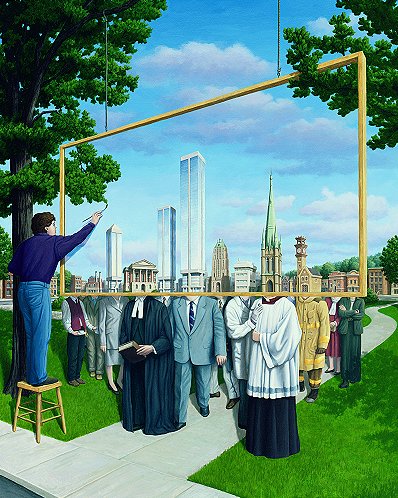
Subscribe to:
Posts (Atom)